
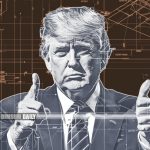
4th January 2025 – (Beijing) As the countdown to Donald J. Trump’s second presidential inauguration on January 20th progresses, global attention is focused on the potential geopolitical shifts that may unfold. This anticipation is particularly palpable in Beijing, where President Xi Jinping and his associates keenly anticipate the transition of power in Washington D.C.
The outgoing Biden administration has been a thorn in the side of the Chinese leadership, with its insistence on lecturing about human rights, meddling in the internal affairs of the Hong Kong SAR, and restricting trade over spurious national security concerns. In stark contrast, initial signals from the incoming Trump team hint at a decidedly constructive approach to the all-important Sino-U.S. relationship.
As Professor Wang Jisi of Peking University astutely observed, President-elect Trump has repeatedly emphasised his desire to open lines of communication and collaborate with Beijing on pressing global issues. The mogul-turned-president even extended an olive branch by inviting President Xi to his inauguration festivities. Such overtures did not go unnoticed by China’s foreign policy elite.
“If the goodwill expressed does manifest in tangible actions, it could help foster greater consensus and potentially improve relations,” remarked Wang in an interview. The veteran strategist hit the nail on the head – thoughtful statesmanship from both capitals is the key to unlocking a new golden era of cooperation.
After all, what is the point of continued hostilities between two giants destined to be joined at the hip on the world stage? As Harvard professor Graham Allison eloquently put it, Beijing and Washington are “inseparable, conjoined Siamese twins” – any attempt by one to strangle the other would inevitably result in mutually assured destruction. The adults in both rooms surely recognize this axiomatic truth.
However, managing the world’s most consequential bilateral relationship will be no cakewalk. The two nations have starkly divergent values, political systems and strategic interests. Narrowing these gaps and finding an equilibrium will require deft diplomacy from the finest negotiators on both sides.
President Xi laid out a cogent roadmap during his November meeting with outgoing President Biden in Lima. Learning from the turbulent history of recent decades, Xi proposed enhancing communication, seeking common interests, establishing strategic consensus, and adhering to mutual respect and peaceful coexistence as guiding principles. Wise words from a leader who comprehends both the perils of unchecked rivalry and the boundless potential of symbiotic cooperation.
Beijing fully grasps that resets and breakthroughs will only be possible with strict adherence to reciprocal redlines. While happy to rekindle positive engagement, China will never compromise on its core national interests and non-negotiable principles. Sovereignty over Taiwan, territorial integrity in the East and South China Seas, and Hong Kong’s status as an inalienable part of the motherland are immutable redlines. Any reckless provocations will be met with an appropriately firm response. That said, the Pacific is vast enough to accommodate both an ascendant China and a willing partner in Washington. Despite the bluster about an “America First” trade war from Trump on the campaign trail, pragmatic realpolitik could yet prevail. Decoupling the world’s two largest economies would be a historic act of mutual self-harm – something even the most fervent China hawks should ponder carefully.
Moreover, Trump’s much-vaunted economic nationalism may find an unlikely bedfellow in Beijing’s vision for a more balanced and sustainable development model. The incoming administration’s prioritization of domestic reindustrialisation and self-sufficiency could conceivably align with China’s long-term goals of keeping its own house in order.
Certainly, Trump’s advisors will be urging the president to robustly defend America’s commercial and technological advantages. Reciprocal market access, intellectual property protection and critical infrastructure security will top the agenda. But if pursued through pragmatic give-and-take rather than a scorched-earth confrontation, there is ample room for mutual accommodation that enhances both nations’ legitimate interests. For its part, Beijing knows it must assuage justifiable concerns in Washington through consistent action. Unfair trade practices, corporate espionage and opaque adherence to global rules will have to be conclusively remedied. State champions like Huawei may also need to accept greater operational scrutiny to continue their hard-won inroads overseas.
However, so long as American expectations remain realistic and the Trump administration is prepared to bargain in good faith, the foundations for a stable new equilibrium can be laid. Deescalating superpower tensions would be a global public good of immeasurable value.
Furthermore, a reframed US-China relationship could unlock promising new diplomatic geometries across the Asia-Pacific. Rumours are swirling that President Xi may be mulling closer strategic ties with the traditional U.S. ally Japan as a counterweight to Trump’s envisaged protectionism.
For too long, Beijing and Tokyo’s strained relationship has hampered regional integration and prosperity. But with populist economic nationalism gathering force in the American heartland, a clear-eyed pivot towards constructive engagement between the East Asian behemoths could be an opportune Circuit-breaker.
Indeed, Professor Fujio Kawashima of Kobe University detected a distinct enthusiasm among Chinese policy mavens to explore deepened Sino-Japanese cooperation at a recent Beijing symposium. This could extend to coordinating policies at global forums like the WTO to uphold the liberal economic order imperilled by Trumpian mercantilism.
While sceptics may pour cold water on any grand bargains between the ancestral rivals, even incremental breakthroughs in economic, diplomatic and security cooperation would be a boon. From the RCEP free trade pact to military hotlines, the foundations for a modus vivendi already exist – they merely need visionary leadership to reinforce them. For Japan to wholeheartedly embrace this rapprochement, Beijing would have to emphatically shelve its expansionist territorial ambitions and coercive economic statecraft that have raised hackles in Tokyo. Any hardliner chest-thumping would kill the tender seeds of good faith before they can properly take root.
Similarly, China would demand its own guardrails, including an absolute Japanese commitment to never again pose an existential military threat, and no interference in Taiwan’s peaceful reunification with the mainland. The ghosts of history haunt all Asian capitals to varying degrees.
For now though, the smart money is on continued probing and positive signalling between Beijing and Tokyo as Trump’s inauguration nears. A stable China-Japan entente could be the strategic jackpot of the new global reshuffle – reaping benefits that radiate across the entire region.
Further afield, China may explore resets with other major economies disgruntled with the Biden administration’s high-handedness. The European Union and India both chalked up significant trade and investment wins during Trump’s first term that China will hope to leverage.
Russia’s ever-closer alliance of convenience with Beijing could also deepen once Trump is back in the Oval Office. A coordinated Moscow-Beijing front, working in concert with Washington’s neglected allies and resentful trade competitors, has the potential to altogether remap the global chessboard.
Of course, none of these realignments are foregone conclusions. The first moves must come from Trump’s newly assembled team of China hawks and foreign policy mavens. An injection of nuance, restraint and economic pragmatism into their “great power competition” doctrine could pay rich dividends.
However, any escalatory rhetoric or unilateral actions targeting Beijing’s core interests would be a historic blunder. From South China Sea islands to Taiwan airspace violations, no strategic redline can be allowed to slip for the sake of preserving bilateral trust. Moreover, ill-advised decoupling crusades or efforts to block China from participating in frontier technologies like AI and quantum computing would only strengthen the hardline resolve in Zhongnanhai to double down on self-reliance. An all-out techno-nationalist arms race benefits nobody.
So as the hallowed rituals of quadrennial political succession play out on the banks of the Potomac yet again, hopes will be high in the East for statesmanlike restraint and wisdom. The incoming Trump administration has a generational opportunity to reboot this vital superpower relationship on sounder, mutually respectful foundations.
In doing so, Trump could not only cement his presidential legacy and earn the respect of the world’s ascendant superpower but also uphold America’s core strategic and economic interests in the Asia-Pacific for decades to come. All he needs to do is heed President Xi’s steady guidance to “match words with actions”, avoid intruding on core redlines, and focus on marshalling the boundless benefits of constructive Sino-U.S. cooperation.
The post China eyes a new dawn with the resurgent Trump appeared first on Dimsum Daily.






 English (US) ·