
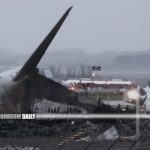
4th January 2025 – (Seoul) The recent Jeju Air disaster, which led to the loss of 179 lives, has sparked urgent discussions regarding safety protocols at Muan International Airport in South Korea. Many pilots and flight instructors have voiced their concerns, revealing they were unaware of the presence of large concrete barriers at the end of the runway, mistaking them for mere earth mounds.
On 29th December, 2024, the Boeing 737-800 encountered a birdstrike shortly after take-off, prompting an emergency landing attempt. Tragically, during the second landing attempt, the aircraft collided with the concrete barrier, resulting in a catastrophic explosion and the loss of nearly all onboard, except for two crew members.
Experts have highlighted the unusual height of the concrete barriers, which stand at nearly two metres, suggesting that such structures pose significant risks to aircraft during landings. David Learmount, a U.K. aviation safety expert, stated that having the localiser antenna supported by a robust wall so close to the runway was both unusual and unsafe.
Amidst the investigation, concerns have been raised about the airport’s birdstrike risk. Flight instructors have indicated that, despite monitoring bird activity through systems like ATIS, bird collisions remain a common hazard, particularly with larger birds that do not shy away from aircraft.
Moreover, while Muan airport officials assert that the construction of the barrier met safety standards, aviation analysts argue that the risks associated with such structures necessitate clearer guidelines and perhaps the use of alternative materials that could mitigate the impact of a potential crash.
The post Jeju Air crash highlights pilots’ ignorance of runway concrete barriers appeared first on Dimsum Daily.








 English (US) ·